 CannaGLAP
Phosphorus Deficiency in Cannabis: Signs and Fixes
Your lower leaves look dark, dull and almost blue, and the stems are going purple. That can mean a phosphorus problem, but it is often cold roots or simply the strain. Here is how to sort it out before you reach for a bloom booster.


“Purple stems, moody blue leaves. Am I hungry or just a little chilly?”
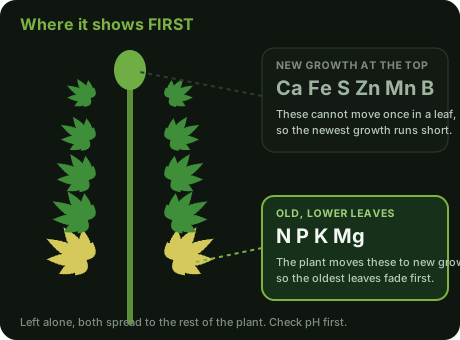
Where it shows
Lower leaves and their stems.
What it looks like
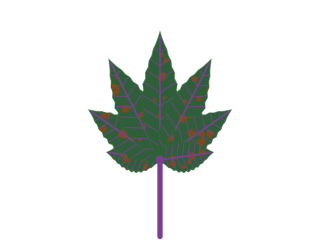
Leaves go unusually dark, dull blue-green with a lifeless matte finish, and stems flush deep purple-red. Bronze blotches follow.
How to confirm it
- Look at the lower leaves and their stems first.
- Leaves turn unusually dark and dull blue-green, with a flat, lifeless finish.
- Leaf stems flush deep purple-red, often along with the main stem.
- Bronze or brown blotches show up on the affected leaves as it progresses.
- Check the rest of the plant. Purple stems with vigorous, healthy growth are usually genetic.
Why it happens
Often cold roots rather than a shortage. Phosphorus uptake falls off sharply below about 60°F. Some strains also just have purple stems genetically, which is not a deficiency at all.
- Cold roots. Phosphorus uptake drops off sharply below about 60°F, even when plenty is present.
- Cold, wet soil that keeps roots chilled and short of air.
- pH outside the range the roots need: 6.2 to 6.8 in soil, 5.8 to 6.2 in coco or hydro.
- A genuine shortage in a tired or very light soil mix.
- Strain genetics. Some plants simply grow purple stems, which is not a deficiency at all.
How to fix it
- Check root-zone temperature first. Cold, wet soil locks phosphorus out no matter how much is present.
- Confirm it is not genetic. Purple stems with otherwise healthy growth are usually just the strain.
- If real, a soluble source works this week; bone meal takes months and will not rescue anything mid-flower.
- Measure the root zone temperature. If it is cold, warm the room at night or lift pots off a cold floor.
- Confirm it is not genetic. If growth is strong and only the stems are purple, leave it alone.
- Check and correct pH before adding any feed.
- If the shortage is real, use a soluble phosphorus source, such as a high-P bat guano tea or a bloom feed at label rate, so it works this week.
- Do not rely on bone meal for a rescue. It takes months and will not help mid-flower.
Organic options
High-P bat guano
Steep as a tea or use a fine powder for a quicker effect than dry meals. Follow the label rate, and wear a dust mask when handling dry guano.
Fish bone meal
A moderately available source to mix into soil or top dress in veg or early flower. Water it in well.
Bone meal
Slow release over months. Mix it into soil before planting so it is available later. It is prevention, not a rescue.
Soft rock phosphate
Very slow and gentle. Best blended into a new soil mix. It works better in slightly acidic soil.
Worm castings
A mild all-round boost that supports root health. Top dress in veg or early flower.
Read and follow every product label. Organic friendly does not mean certified organic; check the listing if that matters to you.
Veg or flower?
Plants use more phosphorus once flowering starts, so a shortage often shows in early bloom. In mid to late flower only soluble sources act fast enough, and heavy bloom boosters can cause other problems, such as zinc lockout.
Prevent it next time
- Keep the root zone above about 60°F, especially at night.
- Raise pots off cold concrete floors with a stand or a block.
- Mix a slow phosphorus source into soil before planting.
- Keep pH in range and avoid soggy, cold soil.
- Note your strain's normal stem color early so you are not fooled later.
Questions growers ask
Are purple stems always a phosphorus deficiency?
No. Many strains have purple stems by genetics, and cold nights can bring out purple color too. If growth is strong and leaves look healthy, it is likely normal.
Can cold temperatures cause phosphorus deficiency?
Yes, and very often. Below about 60°F at the roots, phosphorus uptake falls sharply. Warming the root zone can fix it with no extra feed.
Should I add more bloom booster?
Not without checking first. Too much phosphorus can lock out zinc and other nutrients. Fix temperature and pH, then add only what is needed.
Where these figures come from
These points match published grow books, page by page. They are grower practice, not research: none of these books cites a study, so where science and the books differ, this page follows the science.
- Plants use more phosphorus once flowering starts. Danko (2018), e-book p. 29; e-book p. 108. Green (2001), p. 196 to 197; p. 267. Paull and Zetta (2020), e-book p. 17; e-book p. 119.
- Lower leaves and stems; dark dull blue-green leaves, deep purple-red stems, bronze blotches. Danko (2018), e-book p. 134. Green (2001), p. 330.
Books: Danko, Cannabis: A Beginner's Guide to Growing Marijuana (Hampton Roads, 2018); Green, The Cannabis Grow Bible (4th ed., 2001); Paull and Zetta, Foolproof Guide to Growing Cannabis (2020) and The Cannabis Grow Bible (2020).
Related problems
 Zinc deficiencyNew growth, as a spacing problem rather than a color one.
 Potassium deficiencyLower leaves, around the whole outer edge.
 Nitrogen deficiencyOldest, lowest leaves first, working upward.
Updated 2026-10-20. Written by the Canna GLAP team.